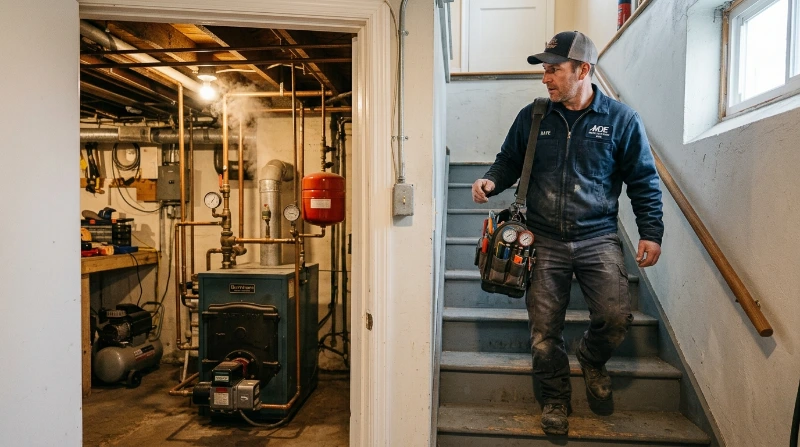
Out on a Ray Township farmhouse call, the first thing we notice is the pipe size. Many of these houses went up in the early 1900s with gravity steam and fat mains sized for a coal boiler, then got a gas boiler in the 1940s or 1950s. The radiators and piping stayed. The boiler in front of them is usually far smaller than the one it replaced.
Let's take a look at the controls. On these big-pipe systems we often find the pressuretrol cranked to 5 or even 10 psi because someone figured more pressure would push heat to the far bedrooms. It does the opposite. These systems were designed to heat every room on a few ounces of steam, as long as the air had a way out.
So we follow the main to the end and check the venting. A farmhouse main can run the full length of the house, and one small vent at the end can't move that much air. We also check the wet return along the floor, which is often original pipe that has rusted from the inside and packed up with sludge.
Then Gary resets the pressuretrol to around half a pound cut-in and under 2 psi cut-out, cleans the pigtail and blows down the low water cutoff. We write the settings on a tag hung at the boiler. Ray Township is a long way from Warren, so we would rather fix the cause once than come back for the same bang next January.