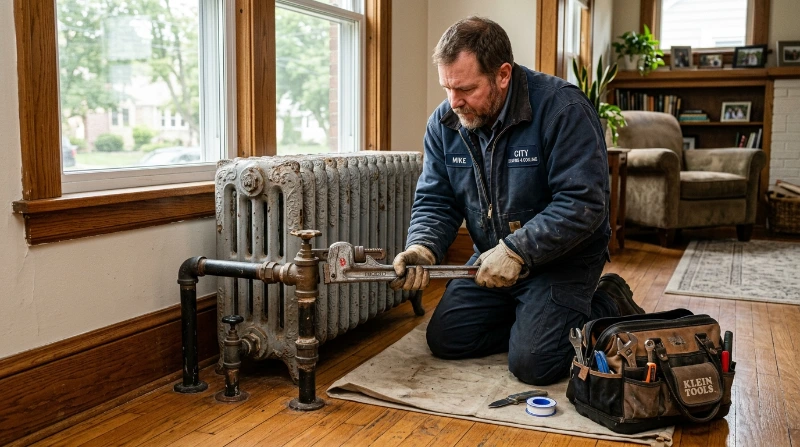
On a one pipe call we start at the boiler and follow the steam out the way it travels. Header, then each main, then to the end of the main where the vent should be. In a lot of Warren brick ranches and bungalows from the 1940s through the 1960s, we find one small vent on a main that really needs two big ones, or a vent that hasn't opened in years.
The steamfitters who first piped these Warren houses designed them to heat on ounces of pressure, not pounds. One pipe steam works on gravity and venting, not force. So the next thing we check is the pressuretrol. If it's set at 5 psi, we bring it down and clean the pigtail before we touch anything else, because more pressure only makes a venting problem louder.
At the radiators we check three things: the valve is fully open, the radiator pitches back toward the valve, and the vent opens cold and closes hot. Vents should be matched to the room. Radiators near the boiler get slower vents and far rooms get faster ones, so the whole house heats at about the same time instead of the front bedroom roasting while the back stays cold.
We show the homeowner how to check a radiator vent. With the system cold, the vent should let air pass. When steam reaches it, it should shut and stay quiet, not keep spitting. Replacing a radiator vent is a safe homeowner job. Re-pitching a main or changing a valve is ours. We write down which vent went on which radiator so next year's balancing starts from a record.