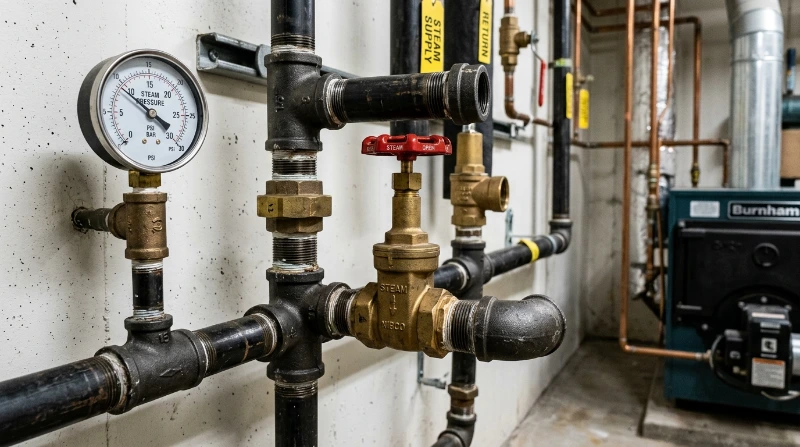
First thing on a two pipe job is figuring out what kind of two pipe system it is. Some are straight two pipe steam with a thermostatic trap on every radiator outlet. Some older ones are vapor systems that were designed to run on ounces of pressure. We look at the radiator valves, the return piping and the controls near the boiler, because the right pressure setting depends on what we find.
Then we check the returns. On a two pipe system the dry return carries air and condensate back, and it drops below the waterline near the boiler to become a wet return. Wet returns rust from the inside and fill with sludge. A plugged wet return backs condensate up into the dry return, and the whole system slows down or starts banging.
Air has to leave a two pipe system somewhere, usually through vents on the dry return near the boiler. If those vents are dead, steam gets held back across the whole house no matter how good the traps are. We check them along with any F&T traps at the end of the mains, and we take a temperature at each radiator outlet.
What the last company often got wrong: pressure turned up to 5 or more to push heat past bad traps, or a one pipe vent screwed into a two pipe radiator. We set pressure back down, usually under 2 psi on a pressuretrol, or a vaporstat if it's a vapor system, and we show the homeowner which radiators had traps replaced and why.