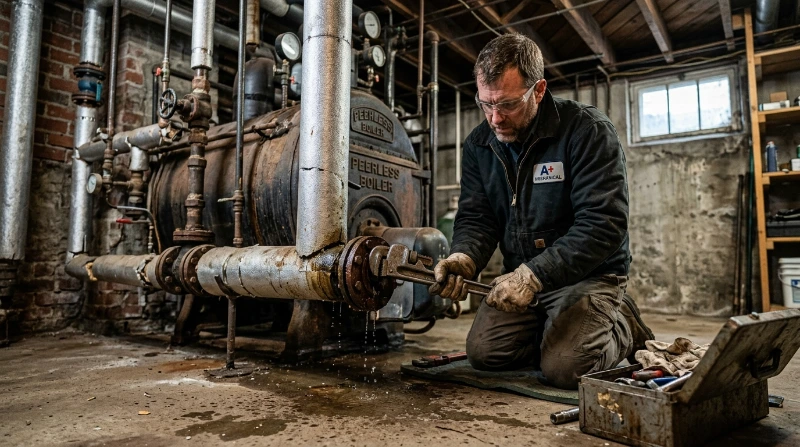
The call usually sounds the same: the living room and front bedrooms are fine, but the far wing never warms up before the thermostat is satisfied. Before we touch the boiler, we walk the basement and follow each steam main from the header to its end. In a house this size the mains can run a long way, and a long main holds a lot of air that has to leave before steam arrives.
At the end of each main we look for the vent. Quite often we find one small vent, or a radiator vent somebody screwed onto the main as a stand in, trying to empty a pipe that needs far more venting capacity. Sometimes the vent is simply plugged with old scale. We clock each main from burner start to a hot vent, and the slow one tells the story.
Then we check pressure. The steamfitters who piped these homes knew a house heats on ounces. If the gauge climbs past 2 psi on a mild day, steam is being shoved around instead of drawn evenly, and the traps in the far wing take a beating. A jumping sight glass also sends us to the near-boiler piping, since priming throws water into the mains. We set the control back down and clean the pigtail so it reads honestly.
Last, we go room by room in the cold wing with an infrared thermometer, checking the inlet and outlet of every radiator. A cold radiator with a hot supply points to a trap that failed closed. We write up what we found, show the homeowner the old vent or trap element, and price each item separately so nothing gets bundled into a mystery number.