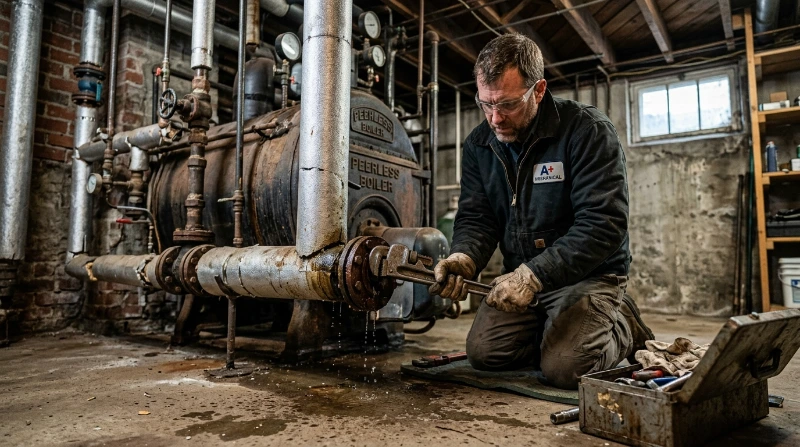
Clinton Township gives us two kinds of steam calls. The ranches off Gratiot are mostly one pipe. The bigger colonials around Moravian Drive and toward Hall Road are often two pipe, and those calls start differently. Let's take a look at the returns first. If a return line near the boiler is too hot to hold your hand on, live steam is getting past a trap somewhere.
Next we work through the house one radiator at a time. Each two pipe radiator has a thermostatic trap on the outlet side. We check the inlet and outlet temperatures. A trap that fails open passes steam into the return. A trap that fails closed leaves the radiator cold at the bottom. Traps that went in together tend to quit within a few years of each other, so we check them all.
We also check the main return for an F&T trap or vented condensate setup, depending on how the original installer built it. Steam in the returns causes banging, uneven heat and a gas bill that climbs every winter. Before we replace anything, we show the homeowner the readings so they can see which traps failed and which still work.
On these 1960s systems we also look at the boiler itself: the near-boiler piping, the pressure setting and the low water cutoff. A good trap job won't fix a boiler set at 5 psi. We set the pressuretrol low, test the LWCO, and leave a list of every trap with its condition. That list makes the next visit faster and cheaper.