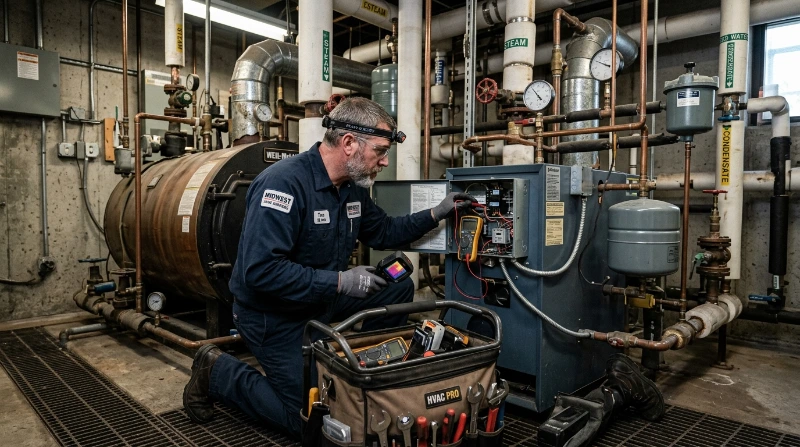
In Utica, the steam homes sit mostly in the older core within about a half mile of downtown. When we get a no-heat call there, the house is often old enough that the homeowner isn't sure what system they have. We start at the radiators: tall cast iron units under the windows mean steam, and that sets the whole plan.
Down in the basement, quick observation first. Is the burner trying to light? Is there water in the sight glass? On many Utica no-heat calls the low water cutoff has done its job and shut the burner off because the water dropped. That's a safety working correctly, not a broken boiler, but it tells us to find where the water went.
If the water's fine, we move to the burner. We confirm a call for heat at the thermostat, check for 24 volts at the gas valve, and test the pilot, thermocouple or igniter depending on the boiler. A hot surface igniter gets an amp draw check. We look at the rollout and spill switches too, because a tripped one says the flue needs attention.
Older downtown Utica homes may have early gravity piping with large mains, and those systems want very low pressure. So even on a no-heat call, we set the pressuretrol low and check the main vents before we leave. Fix the no-heat first, then make sure the system runs the way it was built to run.