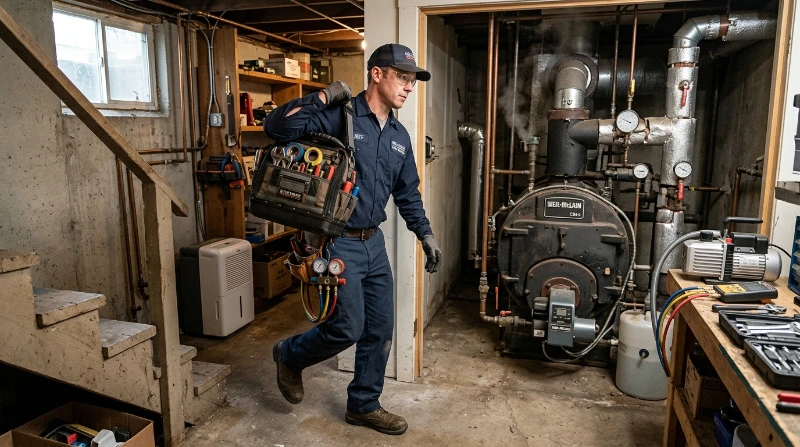
First thing we do on a Weil-McLain is look up, not down. We check the flue pipe from the draft diverter to the chimney: size, pitch, rust holes, and whether the vent connector is crushed where it enters the wall. On older Series 88 and EG units in Warren we often see soot or scale building in the flue passages, and that shows up as poor draft before it shows up anywhere else.
Then we drop the probe into the flue ahead of the diverter and read O2, CO2 and CO. On an atmospheric boiler we want O2 roughly 4 to 9 percent and CO well under 50 ppm. If CO is climbing, we pull the flue collector and brush the passages between sections. A draft test confirms the chimney is pulling negative before we call it done.
Down at the base we follow the sections with a light. Rust trails, white mineral crust, or a damp floor under one section tell a story. A leak at a fitting, a valve or the wet return is a repair. A leak coming from the cast iron itself is a different conversation, and we show the homeowner exactly where it is before anyone says the word replacement.
Last, the controls. We check the pressuretrol and blow out the pigtail, test the McDonnell & Miller style low water cutoff, and watch the automatic feeder through a full cycle. If the feeder keeps adding water, that water is going somewhere. We find out where before we leave, and we write it down.