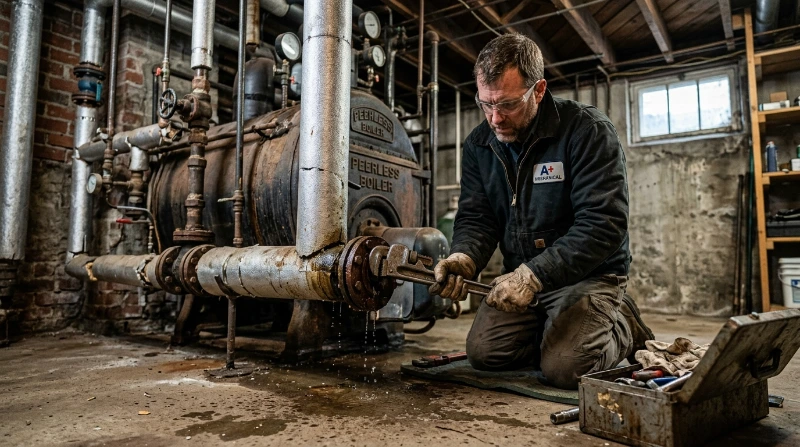
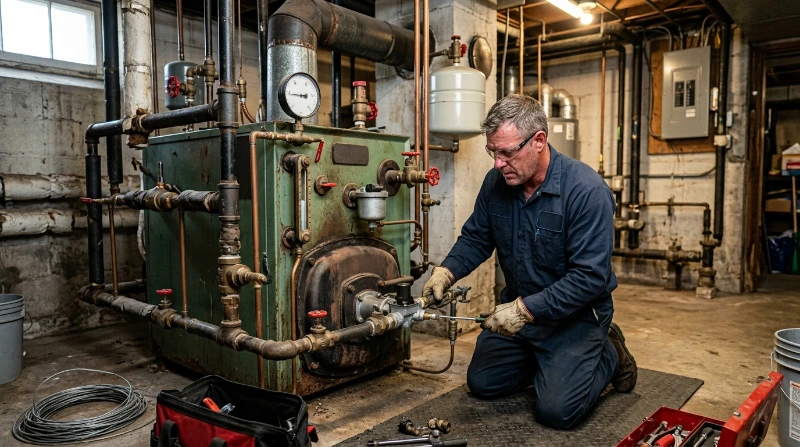
When we walk up to an old cast iron boiler in a Warren basement, quick observation first: the rating plate, the jacket, the floor under it. The plate tells us the make and model, which tells us whether parts are still out there. Rust trails running down the jacket or a white crust at the base are the first hints of a leak between sections.
Then we separate the boiler from everything bolted to it. The cast iron block, the burners, the controls and the piping all wear on different schedules. Most of the time the problem on a 50 or 60 year old unit is a control, a pigtail, a feeder or a leaking nipple in the piping, not the iron. A leaking pipe or valve never means you need a new boiler.
If the feeder has been adding a lot of water, we go looking for where it goes. We check the wet return, the near-boiler piping and the steam side for leaks first. Then we look inside the combustion chamber with a light for wet sections, rust streaks or soot. A cracked section usually shows up as water in the burner area or steam in the flue.
We also run a combustion analysis and a draft test, because a sound block with poor draft is still a problem. Then we give the homeowner a straight answer: what's wrong, what it costs to fix, and if the block is done, what a properly sized replacement looks like. Age alone isn't on that list. Repeated failures and leaking sections are.