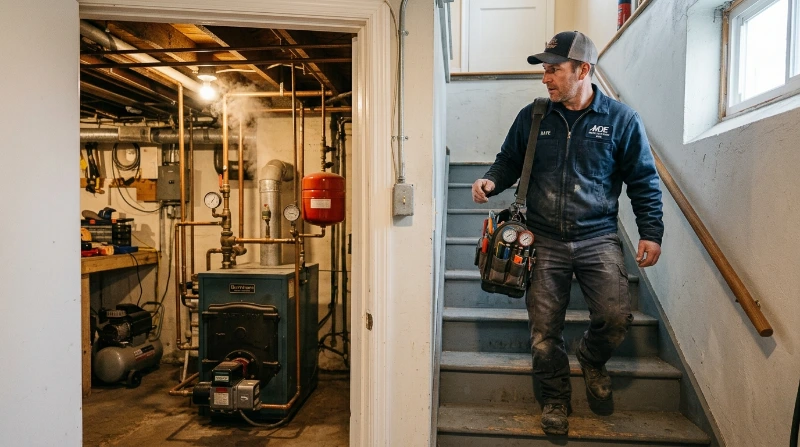
Quick observation first, with the boiler off: water line in the gauge glass, rust or weeping at the fittings, any drip trail under the relief valve, the pigtail and the pressuretrol setting. Then we fire it and test the low water cutoff. A float type gets blown down; a probe type gets drained below the probe. If the burner doesn't shut off on that test, the boiler stays off until it's fixed.
Next is combustion. We put the analyzer probe in the flue before the draft hood and read O2, CO2, CO and efficiency. On an atmospheric gas boiler we're usually looking for O2 around 4 to 9 percent and CO well under 50 ppm, then a draft test to confirm negative pressure. The printout gets taped to the boiler so the next tech can compare.
Then the water side. We watch whether the water line bounces or looks oily, and skim or flush if it does. We pull and clean the pigtail, make sure the pressuretrol cuts out under 2 psi, and walk the mains out to the end vents. On two pipe homes we take a temperature across the traps. On one pipe homes we look for radiator vents that hiss or spit.
Last, we teach. We show the homeowner the five valves worth knowing: gas to the boiler, water feed to the boiler, gas to the water heater, the main water shutoff and the emergency switch at the top of the stairs. We tag them. We show how to test the low water cutoff per the manual, and we leave a log sheet so every test gets written down.