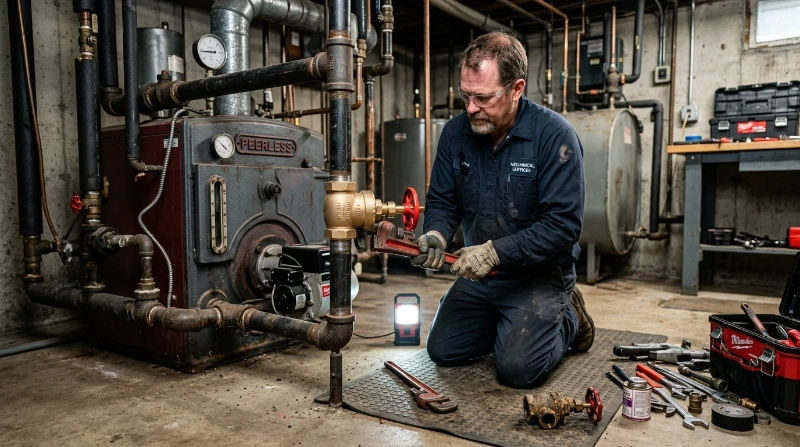
On a trap call we don't start at the cold radiator. We start at the boiler, because if live steam is showing up in the returns, it can hide the trap that's actually bad. We look at the dry return near the boiler and the condensate receiver if there is one. A return pipe too hot to keep your hand on tells us at least one trap upstream is blowing through.
Then we go radiator by radiator. With the system running, the supply side should be hot and the pipe past the trap should be noticeably cooler. If both sides are scalding, that thermostatic element has failed open. If the radiator is cold and the trap body is cold too, the element has likely failed closed or the trap is plugged with scale. We mark each one on a sketch of the house.
Most residential radiator traps are thermostatic, often old Hoffman bodies. Many can take a new element or a rebuild kit instead of a full replacement, if the seat isn't chewed up. The bigger F&T traps at the end of mains and on drips are a different animal, and we size those by the condensate load, not by whatever fits the pipe.
What we see go wrong most is a previous fix where someone screwed a one pipe air vent onto a two pipe radiator, or turned the pressure up to push heat past bad traps. That masks the problem for a week. Before we leave we hand the homeowner the trap map, so next season anyone can see which traps were replaced and when.