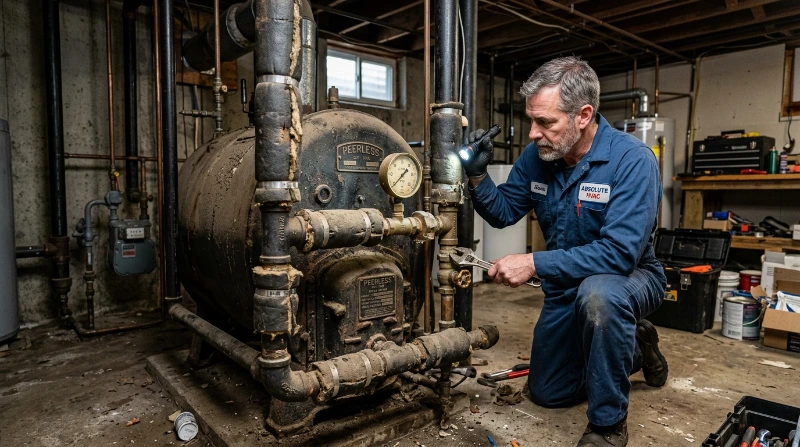
Let's take a look at the flame first. On Peerless 63 and 64 series boilers in Warren basements we often see burners that have collected rust flakes and lint over the years. The flame goes yellow and lazy, lifts off the ports, or rolls out toward the front. We pull the burners, clean them, and check the orifices before we touch anything else on the boiler.
Next come the gaskets and seals. On older Peerless units we often find worn gaskets around the flue collector, the canopy or the burner access, and sometimes old sealant that has dried and cracked. That lets flue gas wander where it should not. We run a combustion analysis and a draft test so the numbers, not a guess, decide what gets resealed.
Then we work the steam side. We blow down the low water cutoff and make sure the burner stops. We check the pressuretrol and run a wire through the pigtail. We watch the sight glass while the boiler makes steam: a steady line roughly half to two thirds up is what we want. A jumping line points to dirty water and a skim.
Before we leave, we walk the homeowner through the five valves: gas to the boiler, water feed to the boiler, gas to the water heater, main water shutoff, and the emergency switch at the top of the stairs. Gary tags each one. If the Peerless ever acts up at 2 a.m., nobody should be hunting for a shutoff with a flashlight.