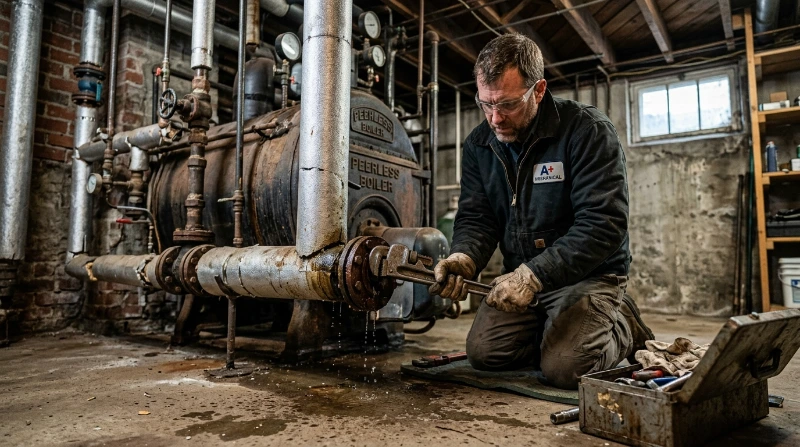
We stand and look before we touch a thing. In a lot of Algonac homes off St. Clair River Drive the basement air is damp most of the year, and you can see it on the near-boiler piping. We look for rust bloom on the Hartford Loop fittings, white crust on the wet return, and drips under the equalizer. Moisture from the river side works on that iron from the outside while sludge works on it from the inside.
Next we follow the wet return along the floor back to the boiler. That pipe sits below the water line and stays full all season, so it rusts from the inside out. On a 1920s or 1950s system it is often the original pipe. If the automatic feeder has been adding water every day, a pinhole in that return is our first suspect, and we trace the floor for a wet stain or a line of scale.
Then the controls. Gary checks the pressuretrol and the pigtail under it, because a clogged pigtail is common in older Algonac boilers and the gauge will lie to you. We blow down the low water cutoff with the homeowner watching. If the burner does not shut off when the water drops, that is the day's real problem, whatever the original complaint was.
Last, we write it down. Sight glass level, cut-in and cut-out settings, what the LWCO did on the test, and the condition of the return. That note stays with the boiler so the next visit starts where this one ended. On a Weil-McLain or Burnham this old, a written record is worth more than a guess.