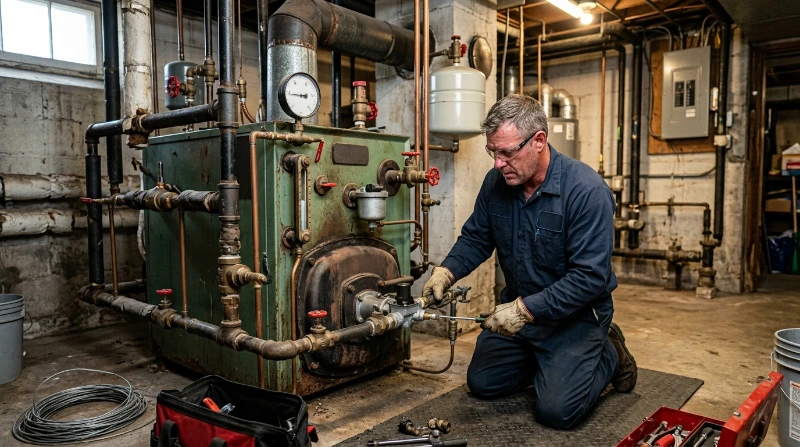
The owner noticed two things: the dining room radiator stayed cold, and the gas bill was up sharply over last winter. In a two pipe house, those two complaints often come from the same source. Before going upstairs, we touched the dry returns in the basement. They were too hot to keep a hand on. In a healthy system they stay much cooler.
Hot returns mean steam is getting past traps that should hold it back. That steam pushes into the return lines, pressurizes them, and stops condensate and air from leaving other radiators. So one bad trap can make a radiator on the far side of the house go cold. We started a survey, radiator by radiator, with an infrared thermometer.
Three traps had failed open, their outlets nearly as hot as their inlets. The dining room radiator had the opposite issue: its trap had failed closed, holding air and water inside. We rebuilt the thermostatic elements where parts were available and replaced the trap bodies that were too worn. The supply valve on the dining room unit also needed repacking.
With the traps fixed, the returns cooled within a cycle and the dining room heated evenly. We checked the boiler pressure, which was set higher than a two pipe system like this needs, and lowered it. We left a written trap map at the boiler showing every radiator and the date each trap was serviced, so the next visit starts with a record.