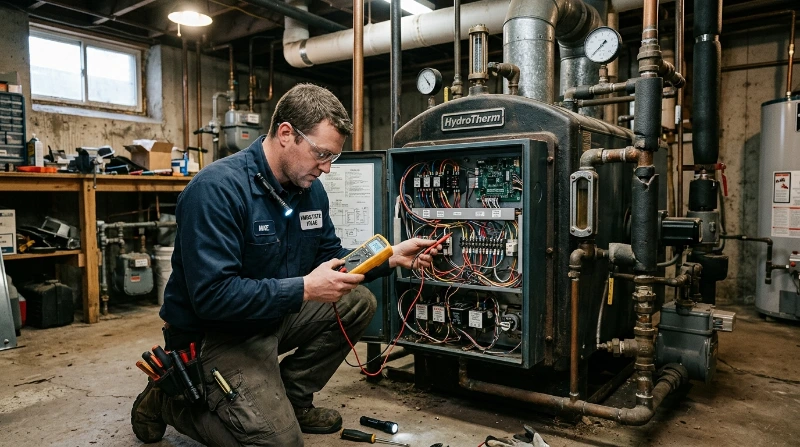
One of the more common Commerce Township calls starts with a homeowner who noticed the boiler's feeder clicking on every day. The house heats, so it does not feel urgent. It is. We start by reading the feeder's counter if it has one, or asking how often it runs, and we look at the floor around the boiler for rust stains and damp spots.
Then we trace the wet return. Unlike the dry return overhead, which carries air and condensate above the waterline, this pipe stays full. In lake houses it often runs along the floor or even below it, and decades of condensate rust it from the inside. We look for pinholes, white mineral crust and soft spots. A return that has rotted through can leak slowly for months before anyone notices, while the feeder quietly covers for it.
If the returns are dry, we check the Hartford Loop connection and the equalizer, then every fitting on the near boiler piping. Steam escaping at a radiator valve packing or a loose union also costs water, just in vapor form. Last we look at the boiler itself. A wet spot or a crusty trail between sections suggests a cracked section, which is the news nobody wants to hear.
Most of the time the culprit is a return or a fitting, not the boiler. We replace the bad pipe, skim and flush the boiler, run a blowdown on the cutoff and refill to the right line. Then we show the owner how to jot down each time the feeder runs on a card by the boiler, so a new leak shows up in days instead of months.