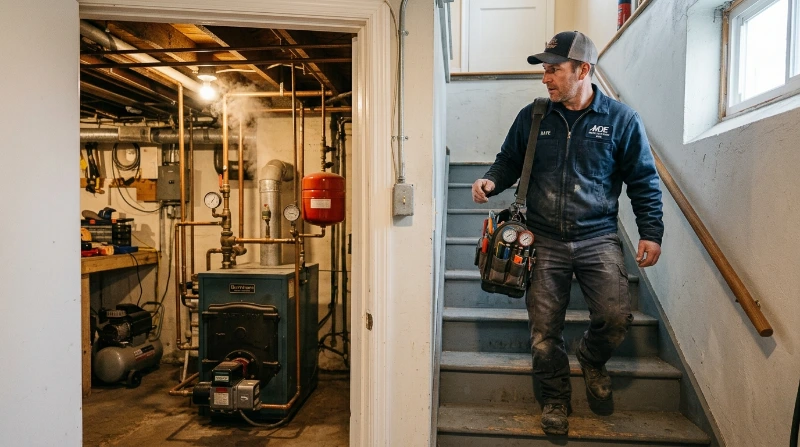
A Milford owner calls after a December gas bill that made them check the meter twice. The house is one of the larger older homes north of the river, and some rooms overheat while others stay cool. Before we head to the basement, we ask which rooms run hot and which run cold. That map usually points to where the trouble is hiding.
Downstairs, we check the dry returns with an infrared thermometer. On a healthy two pipe system they should be warm, not scalding. Hot returns mean steam is getting past one or more traps. We also check the pressure gauge, because a high setting can push steam through traps that would otherwise hold, and the fix there costs nothing but a turn of a screw.
Then we go room by room. At each radiator we read the supply and the outlet. A hot outlet means a trap failed open. A radiator that stays cold with a hot supply has a trap stuck closed or a valve that will not open. In a big house with a dozen or more radiators, we test every one, because one bad trap can upset rooms across the house.
We list every failed trap on the estimate with its location and price, and the owner decides how many to replace now. Some choose to do the worst ones first and the rest in spring. After the work, we fire the boiler and recheck the returns so the owner can feel the difference. We leave a trap map near the boiler for future visits.