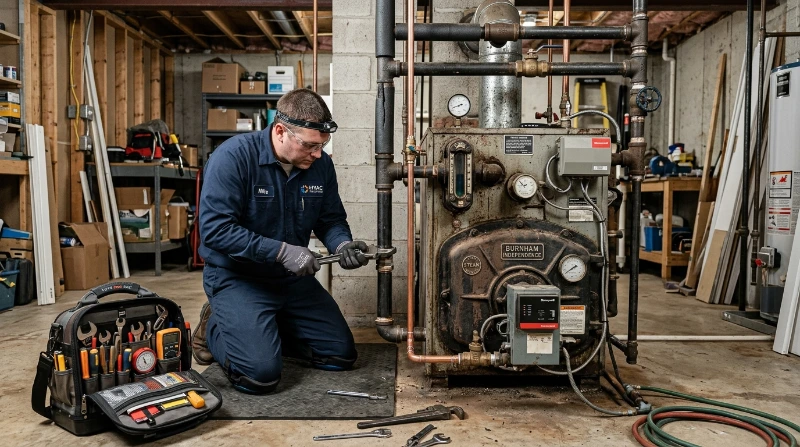
The complaint on the islands is often the same: the living room gets warm, but the bedrooms at the back never catch up. We start by looking at the house from the outside, because a cottage that grew over decades tends to have a steam main that grew too. Then we go down and find the boiler, the header and where each main leaves it.
We follow each main to its end and look for the main vent. Sometimes it is missing, sometimes it is a radiator vent screwed in where something much bigger belongs, and sometimes it is waterlogged and silent. Without a working main vent, air has to leave through the radiator vents, and the rooms closest to the boiler win every time.
Back at the boiler, we check the pressure gauge and the pressuretrol. A higher setting does not help the far rooms. It just makes the near radiators spit and the burner run longer. We also look at the sight glass for a surging line, check the low water cutoff and the flue pipe, since lake moisture tends to rust thin metal faster than in an inland basement.
After the venting is sized for the length of each main, we fire the boiler and time how long steam takes to reach the last radiator. We want every radiator getting steam within a few minutes of the first. We write the vent sizes and pressure settings on a tag at the boiler, so the next service visit starts with the facts.